
How to Reduce Your Electricity Bill in Pakistan: 12 Ways That Work in 2026
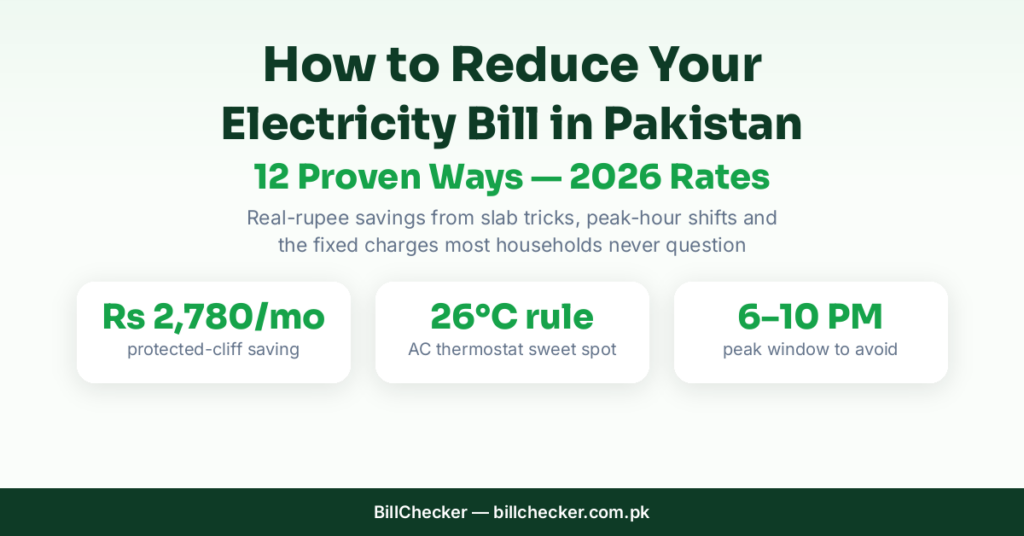
Most of a high electricity bill comes from how the tariff works, not from billing mistakes. Once you know the rules, you can cut the bill with changes that cost little or nothing. These 12 ways use NEPRA’s February 2026 rates.
First, Know What Drives Your Bill
- Your slab. Unprotected homes pay one rate on every unit, based on the slab their total falls in.
- Your category. Protected homes pay less than half the unprotected rate.
- Your sanctioned load. You pay a fixed charge on it every month, even in a quiet month.
- The adjustments. The fuel and quarterly adjustments add rupees to every unit.
Our 2026 tariff guide lists every rate. The tips below attack each of these four drivers.
1. Stay Under 200 Units if You Have Protected Status
This is the biggest single saving for a small home. A protected 2 kW home pays about Rs 2,955 for 200 units, before adjustments and tax. At 201 units, it pays about Rs 7,353.
That higher rate also lasts, because you need six straight months at 200 units or less to get protection back. Our protected vs unprotected guide explains the rule.
2. Stop Just Below a Slab Edge
Unprotected homes face the same kind of jump at every slab edge. For a 2 kW home, 300 units cost about Rs 10,630 before adjustments and tax. At 301 units, the bill rises to about Rs 11,774.
So if you are at 290 units with a few days left, cut back hard. The same applies near 400, 500, 600 and 700 units.
3. Set the AC to 26°C and Use a Fan
The air conditioner is the biggest load in most summer homes. Each degree lower makes the compressor run longer, so 26°C with a ceiling fan uses far less than 18°C.
An inverter AC uses much less power than an old fixed-speed unit. It slows down instead of switching on and off. If you are replacing an old AC, choose an inverter model.
4. Move Heavy Loads Out of Peak Hours
If you have a time-of-use meter, peak units cost Rs 46.85 and off-peak units cost Rs 34.53. Moving 100 units out of peak saves about Rs 1,232 a month, before tax.
Peak hours change with the season, and they are 6 PM to 10 PM from September to November. Our peak hours guide lists every quarter. Single-phase homes pay the same rate all day, so this tip doesn’t change their rate.
5. Switch Off Standby Loads
TVs, set-top boxes, computers and chargers draw power on standby. Each one is small, but together they run all day and night.
Use a switched power strip for the TV corner and the computer desk. Turn it off at night, and the saving costs you nothing.
6. Use LED Bulbs
LED bulbs use far less power than old bulbs and tube lights for the same light. They also last much longer, so they pay for themselves quickly.
7. Clean AC Filters and Check Fridge Seals
A dirty AC filter makes the unit work harder for the same cooling. Clean the filters every two to four weeks in summer.
Close the fridge door on a piece of paper to test the seal. If the paper slides out easily, cold air is leaking, so replace the seal.
8. Lower Your Sanctioned Load
Since February 2026, most homes pay a fixed charge of Rs 200 to Rs 675 per kW of sanctioned load. Your bill prints the load as San Load.
Say your bill shows 6 kW, but your home never uses more than 3 kW. Then you pay fixed charges on capacity you don’t use. Apply to your power company for a lower sanctioned load.
9. Run Full Loads and Skip the Dryer
A washing machine uses about the same power for a half load as a full one. Wait for a full load, and dry clothes in the sun instead of a dryer.
10. Lower the Geyser Temperature
An electric geyser is the AC of winter. Set its thermostat to around 45–50°C instead of the maximum, and switch it off when nobody needs hot water.
11. Keep Heat Out of the House
A white or reflective roof coating keeps the top floor cooler. Close curtains on sunny windows, and seal gaps around doors so cool air stays in.
12. Use Solar for Daytime Power
Solar still cuts bills, but the rules changed in February 2026. New solar users now get net billing. It pays a much lower rate for exported units than the old net metering did.
So the saving now comes from using your own solar power during the day. Run heavy loads while the sun is up, and size the system to your daytime use. Our net billing guide explains the new rules.
Track Your Units Every Week
You can’t manage what you don’t measure. Read your meter once a week, and compare it with the reading on your last bill.
If you are near 200 or 300 units with days left, you still have time to cut back.
Check your latest bill on the page for your power company.
- LESCO bill check
- MEPCO bill check
- FESCO bill check
- IESCO bill check
- GEPCO bill check
- PESCO bill check
- HESCO bill check
- SEPCO bill check
- QESCO bill check
- TESCO bill check
Frequently Asked Questions
What is the fastest way to reduce my electricity bill?
Stay below the slab edge you are closest to. A protected home that stays under 200 units avoids paying about Rs 4,400 more in a month. An unprotected home that stops at 300 units avoids a jump of about Rs 1,144.
Does using appliances at night lower my bill?
Only if you have a time-of-use meter, because those meters charge less for off-peak units. Single-phase homes pay the same rate all day. For them, using fewer units matters more than when they use them.
Why do I pay fixed charges when I use little electricity?
Since February 2026, most homes pay a fixed charge on their sanctioned load every month. It applies even in a low-use month. Lifeline homes are exempt, and other homes can lower it by reducing their sanctioned load.
Is solar still worth it in Pakistan?
For homes with high daytime use, yes, but the economics changed in February 2026. New users get net billing, which pays a low rate for exported units. The saving now comes mainly from using your own solar power during the day.
How does filer status affect my electricity bill?
Home bills of Rs 25,000 or more carry 7.5% advance income tax if you aren’t on the Active Taxpayer List. Filers on the list don’t pay it on home bills. So filing your tax return can lower a large bill.
Sources
- S.R.O. 279(I)/2026 residential tariff schedule, as published on IESCO’s tariff page
- Profit: NEPRA introduces Rs 200–675 fixed monthly charges (12 February 2026)
- NEPRA determination of September 2021, for the lifeline and protected definitions
- Dawn: NEPRA pulls the plug on net metering (February 2026)
- PKRevenue: advance income tax rates on electricity bills for Tax Year 2027
BillChecker.com.pk is an independent website. It isn’t part of any power company, PITC, NEPRA or the Government of Pakistan. Rates change, so always check the figures printed on your own bill.