
Electricity Tariff in Pakistan 2026: Complete Slab Rates Guide (NEPRA)
Open your latest electricity bill and look at the total. Now look at the units consumed. If the amount feels wildly out of proportion to the units, you are not alone — most households in Pakistan have had that exact moment of shock. And in almost every case, the explanation is not a mistake. It is the slab system.
Pakistan does not charge one flat rate for electricity. Your per-unit price climbs as your consumption climbs, and which “category” you fall into — protected, non-protected, or lifeline — can literally halve or double your bill for the same number of units. Understand the slabs, and you understand your bill. Let us break down the complete, current tariff.
What NEPRA Decided for 2026
In January 2026, the National Electric Power Regulatory Authority (NEPRA) approved the federal government’s request to maintain the national uniform electricity tariff. In plain words: the per-unit slab rates did not change for 2026. The decision applies uniformly across every distribution company — LESCO, MEPCO, FESCO, IESCO, GEPCO, PESCO, HESCO, SEPCO, QESCO, TESCO — and K-Electric.
“Unchanged” is good news, but it does not mean your bill stays the same. Fuel price adjustments, quarterly surcharges, and taxes move every month, and your slab position moves with your usage. The base rates below are the foundation everything else is built on.
Non-Protected Domestic Consumers: 2026 Slab Rates
Most residential consumers in Pakistan fall in the non-protected category. Here, electricity is billed in eight slabs — the more units you burn, the higher the rate on each additional block:
| Monthly Units Consumed | Rate (Rs per unit) |
|---|---|
| 1 – 100 | 22.44 |
| 101 – 200 | 28.91 |
| 201 – 300 | 33.10 |
| 301 – 400 | 37.99 |
| 401 – 500 | 40.22 |
| 501 – 600 | 41.62 |
| 601 – 700 | 42.76 |
| Above 700 | 47.69 |
Notice the jump: the first 100 units cost Rs 22.44 each, but anything above 700 units costs Rs 47.69 — more than double. This is the single most misunderstood part of the electricity tariff in Pakistan.
A Worked Example: What 350 Units Actually Costs
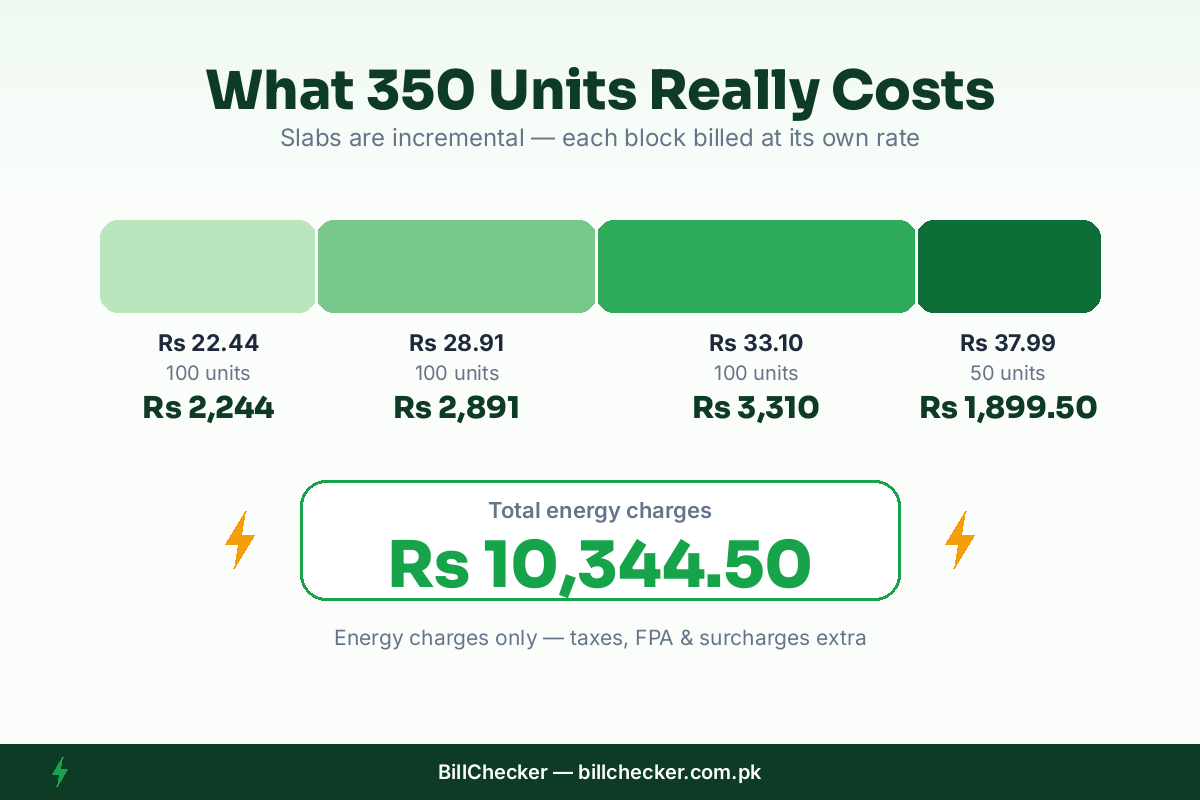
Slabs are incremental — you do not pay one flat rate on all units. For 350 units, the energy charges work out slab by slab:
| Units Block | Rate (Rs/unit) | Cost (Rs) |
|---|---|---|
| First 100 units | 22.44 | 2,244 |
| Next 100 units (101–200) | 28.91 | 2,891 |
| Next 100 units (201–300) | 33.10 | 3,310 |
| Final 50 units (301–350) | 37.99 | 1,899.50 |
| Total energy charges | 10,344.50 |
That Rs 10,344.50 is energy charges only — before FPA, surcharges, GST, and meter rent. Now imagine pushing just 60 more units into the 401–500 slab at Rs 40.22. Small usage increases near a slab boundary cause disproportionate bill jumps, which is why summer AC months feel so punishing.
Protected Consumers: Half the Rates, One Strict Rule
If your household consistently uses 200 or fewer units a month, you qualify as a protected consumer — and the discount is enormous:
| Monthly Units Consumed | Rate (Rs per unit) |
|---|---|
| 1 – 100 | 10.54 |
| 101 – 200 | 13.01 |
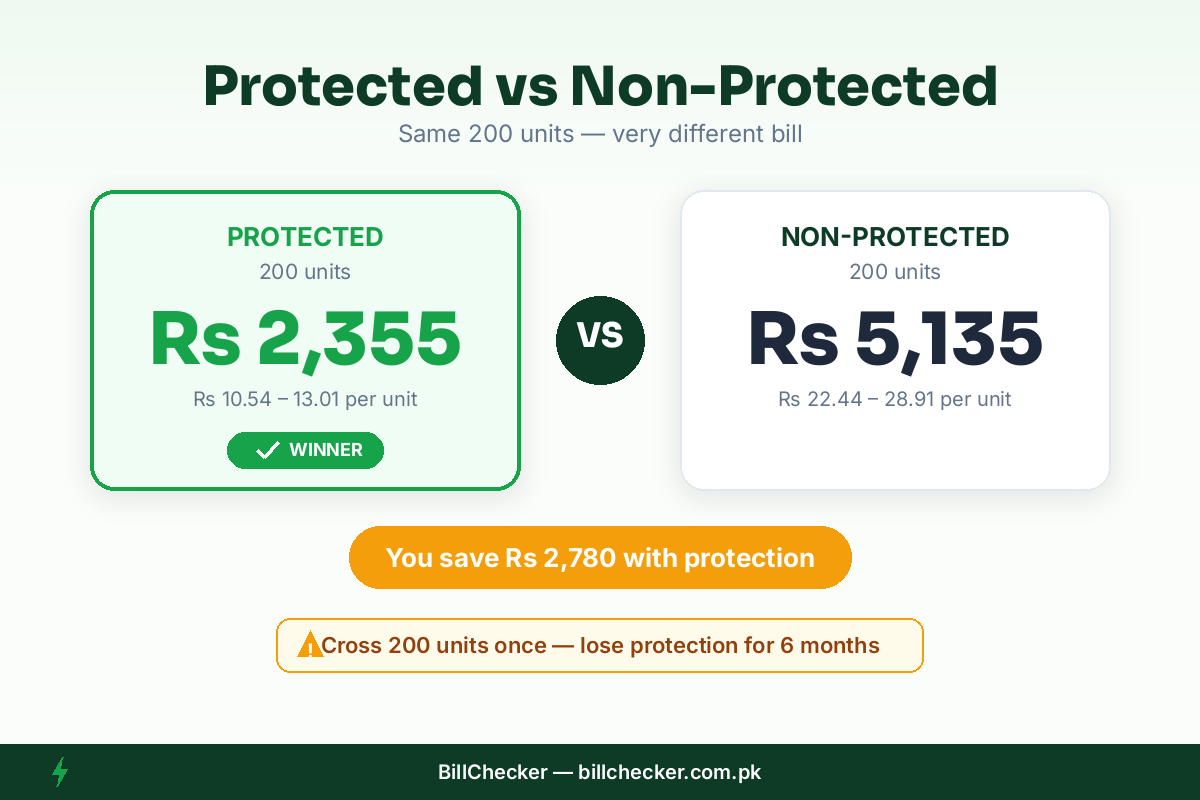
Compare: a protected consumer pays Rs 10.54 for the first 100 units while a non-protected consumer pays Rs 22.44 for the same units. But protection has a trapdoor — exceed 200 units in any single month and you lose protected status entirely, with your whole consumption billed at non-protected rates. Worse, you must then stay under 200 units for six consecutive months to earn it back. One careless month of air-conditioning can cost you the discount for half a year.
Lifeline Consumers: Relief for the Lowest Usage
Households at the very bottom of usage get lifeline rates — the cheapest electricity in the country:
| Monthly Units Consumed | Rate (Rs per unit) |
|---|---|
| Up to 50 | 3.95 |
| 51 – 100 | 7.74 |
How to Check Which Category You Are In
Your consumer category — Protected, Non-Protected, or Lifeline — is printed on every bill near the top, right next to your reference number. The fastest way to see it is to pull up your duplicate bill online right now:
- Check LESCO bill — Lahore & Central Punjab
- Check MEPCO bill — Multan & South Punjab
- Check FESCO bill — Faisalabad & West Punjab
- Check IESCO bill — Islamabad & Potohar
- Check GEPCO bill — Gujranwala & North Punjab
- Check PESCO bill — Peshawar & Khyber Pakhtunkhwa
- Check HESCO bill — Hyderabad & South Sindh
- Check SEPCO bill — Sukkur & North Sindh
- Check QESCO bill — Quetta & Balochistan
Why Your Bill Is Higher Than the Slab Rate
The slab tables above show energy charges only. A real electricity bill in Pakistan layers several more charges on top:
- Fuel Price Adjustment (FPA) — Monthly adjustment for fuel cost changes — can add several rupees per unit in some months.
- FC surcharge and quarterly tariff adjustments — Fixed add-ons set by NEPRA each quarter.
- Taxes: General Sales Tax (GST) on the energy charges, plus income tax for non-filers in higher slabs.
- Fixed charges: PTV licence fee (Rs 35), Neelum-Jhelum surcharge, and meter rent.
This is why the “effective per unit” on your bill always looks worse than the slab table. Diagnostic rule: if your units stayed steady but the amount jumped, blame surcharges or a slab change. If the units themselves spiked, suspect a wrong meter reading or a faulty meter — and get it checked before paying.
How to Keep Yourself in a Cheaper Slab
- Guard the 200-unit line. If you are protected, treat 200 units as a hard ceiling. Shift heavy loads (iron, water motor, washing machine) to off-peak hours and track units weekly from your meter, not monthly from the bill.
- Respect the 300-unit boundary. Crossing 300 pushes you into Rs 37.99+ territory on every additional unit — the steepest part of the curve for middle-class households.
- Read your own meter. Estimated readings are a classic cause of slab jumps: underestimated for months, then one “actual” reading dumps everything into a higher slab at once.
- Time heavy usage for off-peak hours. If you are on a time-of-use meter, peak-hour units cost significantly more — run the AC and ironing at night.
Frequently Asked Questions
What is the current per-unit electricity rate in Pakistan?
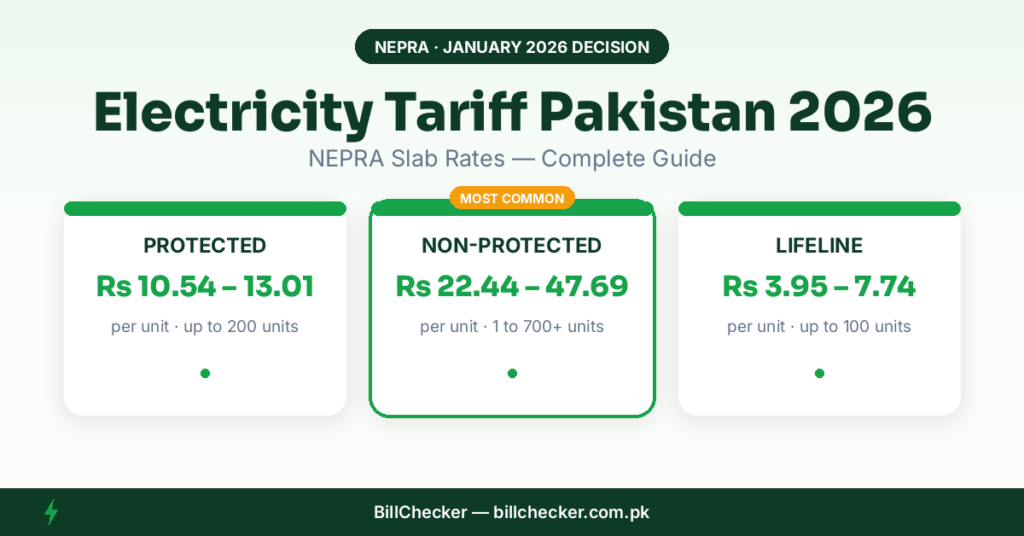
For 2026, NEPRA kept the slabs unchanged: non-protected domestic consumers pay Rs 22.44 to Rs 47.69 per unit depending on usage, protected consumers pay Rs 10.54–13.01, and lifeline consumers Rs 3.95–7.74. Taxes and adjustments apply on top.
How do I become a protected electricity consumer?
Keep your monthly consumption at or below 200 units for six consecutive months. Cross 200 even once and you lose the status — and the cheap rates with it.
Why did my bill double when my usage barely increased?
You almost certainly crossed a slab boundary. Because slabs are incremental, the extra units get billed at the higher rate — and if you crossed 200 units as a protected consumer, your entire bill repriced to non-protected rates.
Does the tariff differ between LESCO, MEPCO and other companies?
No. NEPRA sets a national uniform tariff, so the slab rates are identical across all DISCOs. What differs is service quality, billing accuracy, and how each company handles complaints.
Sources
The Express Tribune — “NEPRA maintains basic power tariff nationwide” (Jan 2026).
Pakistan Today — NEPRA’s decision on national uniform electricity tariff (Jan 2026).
Pakistan Observer — Category-wise unit rates for 2026.