
Taxes on Your Electricity Bill in Pakistan: Every Charge Explained
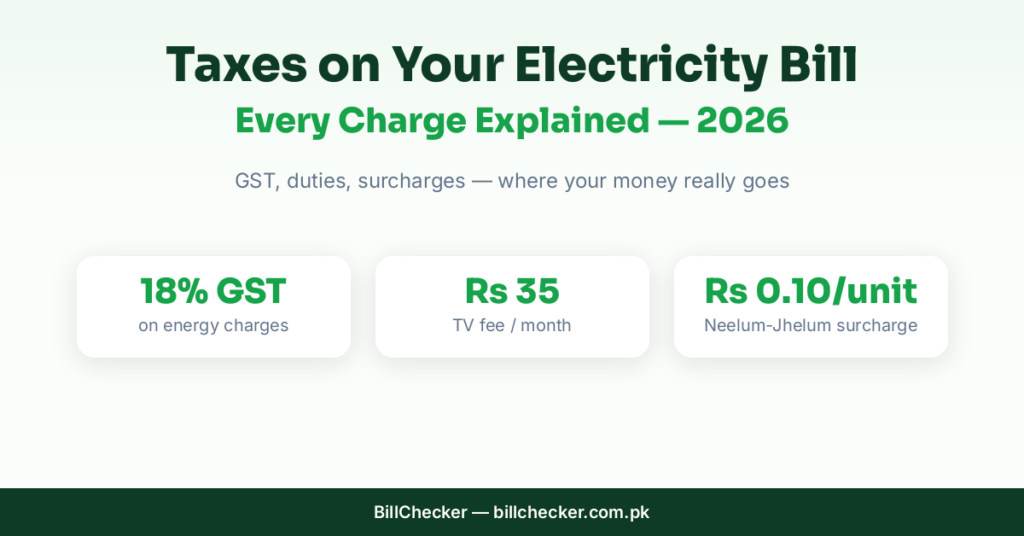
Your electricity bill carries more than the cost of your units. It adds a fixed charge, two adjustments and sales tax, and large bills can carry income tax too. This guide explains every line that appears on a 2026 home bill.
Every Charge on a Home Bill
| Line on your bill | What it is | Current figure |
|---|---|---|
| Electricity charges | Your units multiplied by your slab rate | Rs 3.95 to Rs 47.20 per unit |
| Fixed charges | A monthly charge on your sanctioned load | Rs 200 to Rs 675 per kW |
| FPA or FCA | The monthly fuel price adjustment | Rs 2.3673 per unit on November 2026 bills |
| QTA | The quarterly tariff adjustment | Rs 0.5194 per unit, September to November 2026 |
| GST | General sales tax | 18% |
| Income tax | Advance tax under Section 235 | 7.5% on home bills of Rs 25,000 or more, unless you are on the Active Taxpayer List |
Your bill may also show arrears, instalments or adjustments from earlier months. Those are amounts you owe or credits you get, not new taxes.
Charges That Are No Longer on Your Bill
Two old charges disappeared in July 2025. The Rs 35 PTV licence fee stopped, and the provincial electricity duty stopped too.
Some older bill calculators still add both charges, so their totals come out too high. If your own bill still shows either one with an amount, ask your sub-division office about it.
How Sales Tax Works
Sales tax at 18% is the biggest tax line on most bills. It applies to your electricity charges and the other lines of the bill, including the adjustments.
So any change in your units or the monthly fuel adjustment also changes your sales tax. Saving units cuts the energy charge and the tax at the same time.
Who Pays Advance Income Tax
Advance income tax applies to home bills of Rs 25,000 or more in a month. The rate is 7.5% of the bill.
If the FBR’s Active Taxpayer List includes your name, this tax shouldn’t appear on your home bill. If it still appears, contact your sub-division office with proof of your filer status.
Worked Example: 300 Units in November 2026
Take an unprotected home with a 2 kW sanctioned load that used 300 units.
| Line | Calculation | Amount (Rs) |
|---|---|---|
| Electricity charges | 300 × Rs 33.10 | 9,930 |
| Fixed charges | 2 kW × Rs 350 | 700 |
| Fuel adjustment | 300 × Rs 2.3673 | 710 |
| Quarterly adjustment | 300 × Rs 0.5194 | 156 |
| Sales tax | 18% of Rs 11,496 | 2,069 |
| Estimated total | 13,565 |
In this example, the lines on top of the energy charge add about 37%. Your own bill may differ slightly, because companies round each line.
How to Pay Less Tax on Your Bill
- Use fewer units, because every unit saved also saves its share of sales tax.
- Stay below slab edges, because unprotected homes pay one rate on every unit.
- Ask for a lower sanctioned load if yours is higher than you need, so your fixed charge drops.
- File your income tax return to join the Active Taxpayer List, if your bills often reach Rs 25,000.
Our bill calculator works out each line for your own units. The full rate table sits in our 2026 tariff guide.
Check your latest bill on the page for your power company.
- LESCO bill check
- MEPCO bill check
- FESCO bill check
- IESCO bill check
- GEPCO bill check
- PESCO bill check
- HESCO bill check
- SEPCO bill check
- QESCO bill check
- TESCO bill check
Frequently Asked Questions
What is the sales tax on electricity bills in Pakistan?
Sales tax is 18% on home electricity bills. It applies to your electricity charges and the other lines of the bill, including the adjustments. It is usually the biggest tax line on a home bill.
Is the PTV fee still charged on electricity bills?
No, the Rs 35 PTV fee stopped from July 2025. The provincial electricity duty also stopped at the same time. If either still appears with an amount on your bill, ask your sub-division office about it.
When is income tax charged on a home electricity bill?
Advance income tax of 7.5% applies when a home bill reaches Rs 25,000 or more in a month. It isn’t collected from consumers on the Active Taxpayer List. You can usually adjust it later in your tax return.
Are FPA and QTA taxes?
No, they are price adjustments that NEPRA sets. The FPA tracks monthly fuel costs, and the QTA tracks quarterly fixed costs. Both can be charges or refunds, and sales tax applies on top of them.
Why did my bill rise when my units stayed the same?
The monthly fuel adjustment probably went up, or a new quarterly adjustment started. A higher fixed charge after a slab change can also raise the bill. Compare the FPA, QTA and fixed charge lines with last month’s bill to find the cause.
Sources
- ARY News: PTV fee removed from electricity bills (July 2025)
- Profit: electricity duty no longer collected through bills (July 2025)
- PKRevenue: advance income tax rates on electricity bills for Tax Year 2027
- Business Recorder: NEPRA approves Rs 2.3673 per unit FCA for September 2026
- Business Recorder: NEPRA notifies Rs 0.5194 per unit quarterly adjustment
- S.R.O. 279(I)/2026 residential tariff schedule, as published on IESCO’s tariff page
BillChecker.com.pk is an independent website. It isn’t part of any power company, PITC, NEPRA or the Government of Pakistan. Rates change, so always check the figures printed on your own bill.