
Lifeline Electricity Consumers in Pakistan: Who Qualifies and 2026 Rates
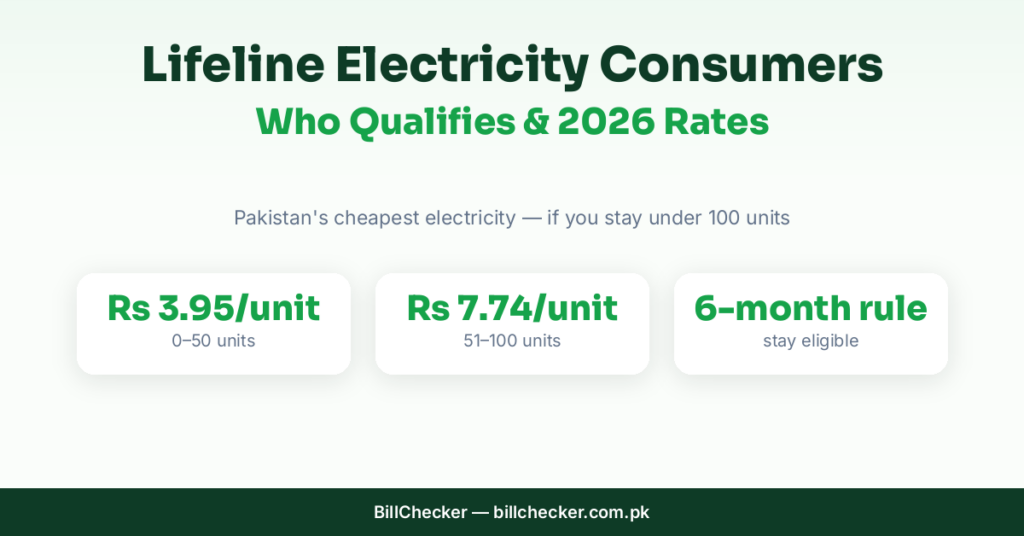
Lifeline is the cheapest home electricity category in Pakistan. A lifeline home pays Rs 3.95 or Rs 7.74 per unit and no fixed charge. You don’t apply for it, because your power company sets it from your meter readings.
This guide explains who qualifies, what the status saves and how a single heavy month ends it.
Lifeline Rates in 2026
| Units in the month | Rate (Rs per unit) | Energy charge at the top of the slab (Rs) |
|---|---|---|
| 1–50 | 3.95 | 198 |
| 51–100 | 7.74 | 774 |
These rates come from NEPRA’s schedule notified on 12 February 2026. Lifeline homes get no slab benefit. So a home that uses 90 units pays 90 × Rs 7.74, which is about Rs 697.
Lifeline homes pay no fixed charge on their sanctioned load. A minimum monthly charge applies instead. It is Rs 75 for a single-phase connection and Rs 150 for three-phase.
Who Qualifies
- Your home is a residential connection without a time-of-use meter.
- Your use is 100 units or less in the current month.
- Your use stayed at 100 units or less in each of the last 12 months.
Your bill prints your category. If it shows lifeline, all three conditions held for that month.
What Lifeline Saves
Lifeline homes skip the monthly fuel price adjustment, which now adds Rs 2.3673 per unit to most bills. They also skip the fixed charge. Here is a 1 kW home that uses 90 units, before tax.
| Category | Energy charge (Rs) | Fixed charge (Rs) | Fuel adjustment (Rs) | Total (Rs) |
|---|---|---|---|---|
| Lifeline | 697 | 0 | 0 | 697 |
| Protected | 949 | 200 | 213 | 1,362 |
The lifeline home pays about half as much for the same 90 units. Our protected vs unprotected guide covers the next category up.
What Happens at 101 Units
One month above 100 units ends lifeline status for that month. Your bill then moves to protected rates, because your last six months stayed under 200 units.
At 101 units, a 1 kW home pays 100 × Rs 10.54 plus 1 × Rs 13.01. It also pays a Rs 300 fixed charge and the fuel adjustment. That comes to about Rs 1,606 before tax and the quarterly adjustment. At 100 units, the same home paid Rs 774.
The cost also lasts. You need 12 straight months at 100 units or less to return to lifeline rates.
How to Keep Lifeline Status
- Read your meter about ten days before the reading date printed on your bill.
- Aim for 90 units, so a hot week or a guest doesn’t push you over.
- Use the iron, water motor and washing machine less often in a heavy month.
- Avoid an electric geyser or room heater, because one winter month can cost a full year of lifeline rates.
- Use LED bulbs and keep the fridge door seal in good shape.
More ideas sit in our guide on how to reduce your electricity bill. The full rate table is in our 2026 tariff guide.
Check your latest bill on the page for your power company.
- LESCO bill check
- MEPCO bill check
- FESCO bill check
- IESCO bill check
- GEPCO bill check
- PESCO bill check
- HESCO bill check
- SEPCO bill check
- QESCO bill check
- TESCO bill check
Frequently Asked Questions
What is the lifeline electricity rate in 2026?
Lifeline homes pay Rs 3.95 per unit for up to 50 units. From 51 to 100 units, they pay Rs 7.74 on every unit. They pay no fixed charge, but a minimum monthly charge applies.
How do I become a lifeline consumer?
Keep your use at 100 units or less every month for 12 months in a row. Your power company then applies lifeline rates automatically. There is no form to fill, because the status comes from your meter readings.
Do lifeline consumers pay the fuel adjustment?
No, lifeline homes are exempt from the monthly fuel price adjustment. Prepaid meters and EV charging stations are also exempt. Protected and unprotected homes pay it.
What happens if I use 101 units?
That month moves to protected rates, so your first 100 units cost Rs 10.54 each. You also pay a fixed charge and the fuel adjustment. You then need 12 straight months at 100 units or less to regain lifeline rates.
Can a home with a time-of-use meter get lifeline rates?
No, lifeline rates cover homes without a time-of-use meter. Homes with a sanctioned load of 5 kW or more usually have these meters. They pay peak and off-peak rates instead.
Sources
- S.R.O. 279(I)/2026 residential tariff schedule, as published on IESCO’s tariff page
- Profit: NEPRA introduces Rs 200–675 fixed monthly charges (12 February 2026)
- NEPRA determination of September 2021, for the lifeline and protected definitions
- Business Recorder: NEPRA approves Rs 2.3673 per unit FCA for September 2026
BillChecker.com.pk is an independent website. It isn’t part of any power company, PITC, NEPRA or the Government of Pakistan. Rates change, so always check the figures printed on your own bill.