
QTA Explained: The Quarterly Adjustment on Your Electricity Bill
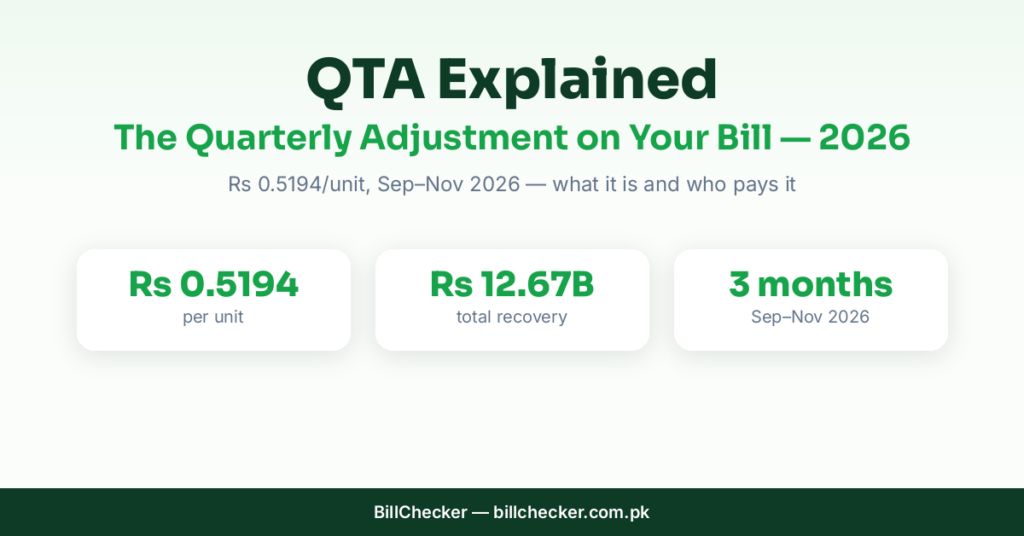
Look at any recent electricity bill and you’ll find a line you didn’t vote for: the quarterly tariff adjustment (QTA). Right now it’s adding Rs 0.5194 to every unit you consume — Rs 12.67 billion in total, collected from September through November 2026. This guide explains what the QTA is, where that number comes from, who is exempt, and how it differs from the monthly fuel adjustment.
What the QTA Is (In One Paragraph)
Power plants get paid in two parts: for the electricity they generate (fuel cost) and for simply being available (capacity charges) — plus grid operating costs. When those fixed costs drift from what NEPRA assumed while setting the tariff, the difference is reconciled every three months through the QTA: a uniform per-unit charge added to everyone’s bill for the next quarter. It is automatic, legal, and applies nationwide.
The Current QTA: Rs 0.5194/Unit (Sep–Nov 2026)
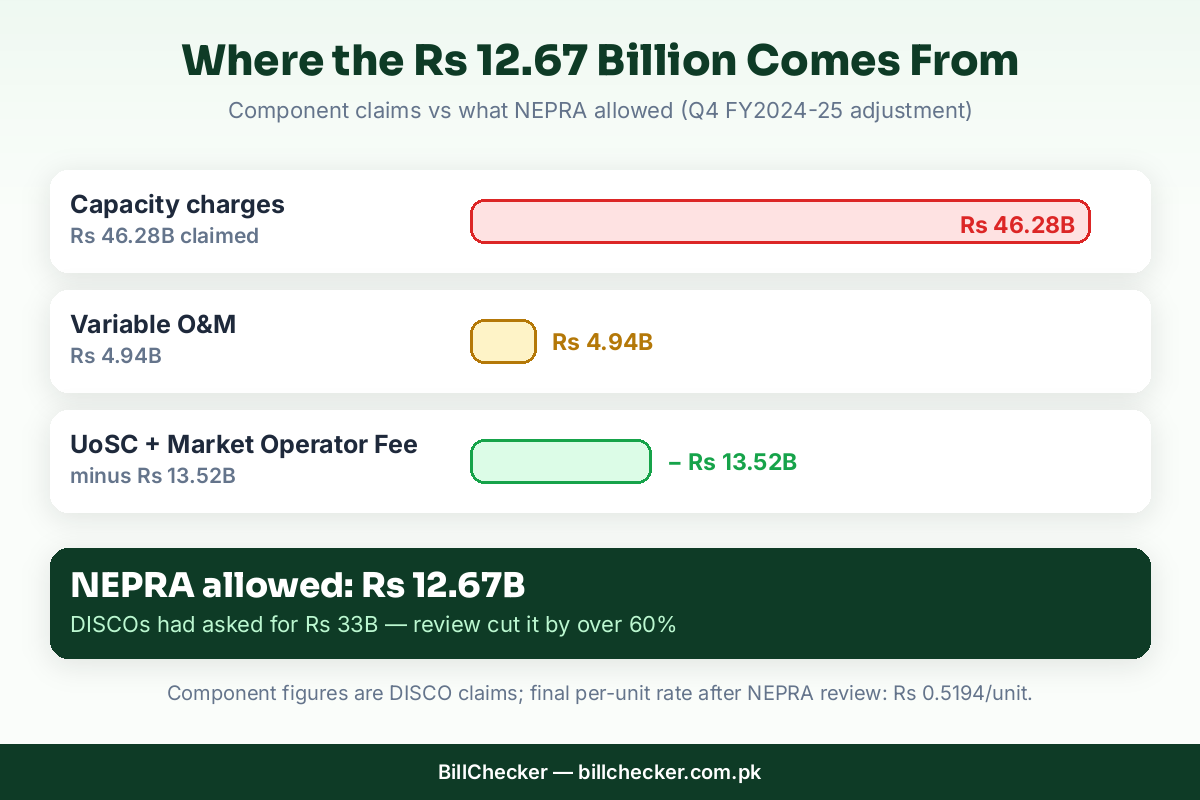
NEPRA notified this QTA on September 8, 2026, covering the second quarter of calendar year 2026:
| Detail | Figure |
|---|---|
| QTA rate | Rs 0.5194 per unit |
| Total recovery | Rs 12.669 billion |
| Recovery period | September, October, November 2026 |
| What DISCOs had asked for | ~Rs 33 billion (NEPRA allowed ~Rs 12.67B) |
| Applies to | All DISCO consumers + K-Electric |
| Exempt | Lifeline consumers, prepaid consumers, incremental-package units |
The Rs 12.669 billion covers: capacity-charge variations (the largest piece — DISCOs claimed Rs 46.28B on this head alone), variable O&M costs (Rs 4.94B claimed), Use of System Charges and Market Operator Fee (a negative Rs 13.52B, offsetting the total), fuel-cost-adjustment impact on transmission and distribution losses, and a HESCO-specific reversal of captive-plant costs.
What It Costs Your Household
| Monthly Units | QTA/Month (Rs) | QTA Over 3 Months (Rs) |
|---|---|---|
| 100 | 51.94 | 155.82 |
| 200 | 103.88 | 311.64 |
| 300 | 155.82 | 467.46 |
| 500 | 259.70 | 779.10 |
A 300-unit household pays about Rs 156 extra per month — Rs 467 over the quarter — purely from this line. Lifeline consumers (up to 100 units) pay nothing.
QTA vs FPA: Don’t Confuse Them
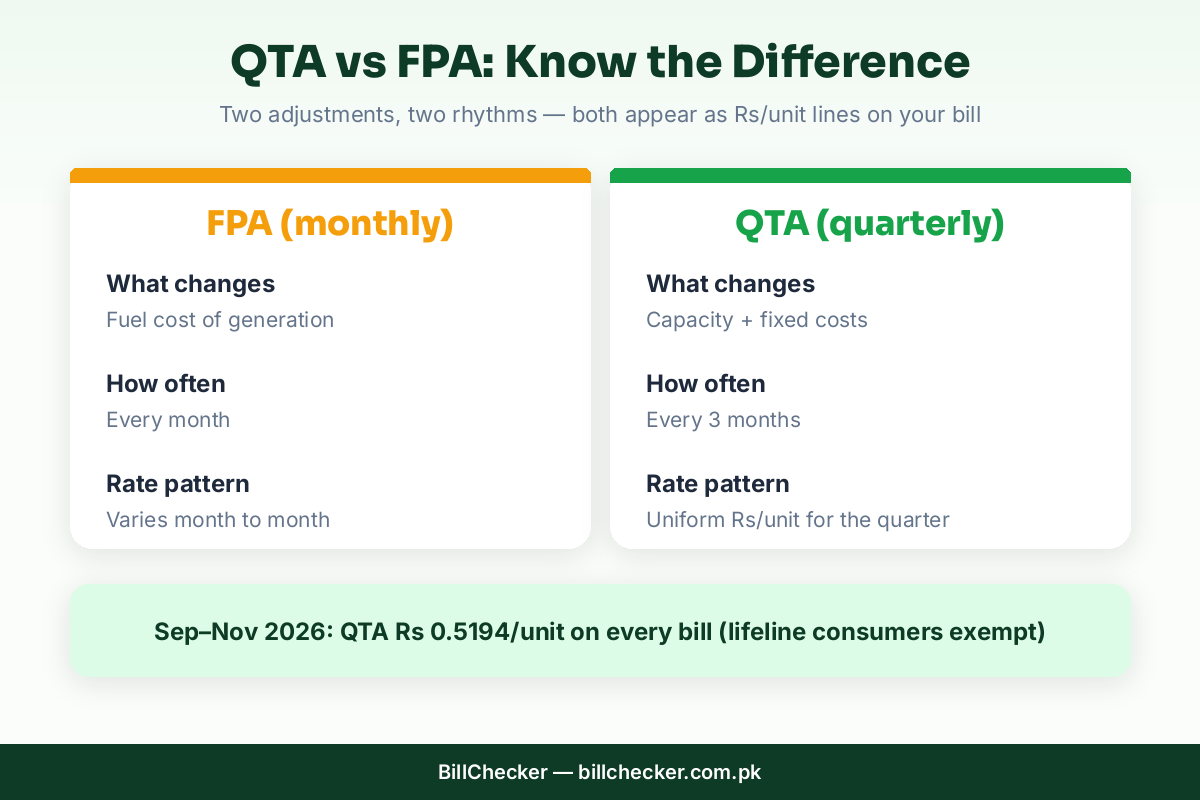
| FPA (Fuel Price Adjustment) | QTA (Quarterly Tariff Adjustment) | |
|---|---|---|
| Adjusts for | Fuel cost changes | Capacity + fixed operating cost changes |
| Frequency | Monthly | Quarterly |
| Current rate | Varies monthly (Rs 2.3673/unit on November 2026 bills) | Rs 0.5194/unit, Sep–Nov 2026 |
| Can it be negative? | Yes — fuel cheaper than reference means a credit | Yes — quarters with lower fixed costs give a negative QTA |
Both stack on the same bill: in September 2026, consumers faced the Rs 2.06/unit monthly fuel adjustment plus the Rs 0.5194/unit QTA — about Rs 2.58/unit combined, or roughly Rs 46 billion across the system over three months.
What Comes After November
The current QTA of Rs 0.5194 ends with November 2026 bills. Earlier reports of a Rs 34 billion request, or about Rs 1.34 per unit, covered this same April to June quarter. NEPRA allowed only Rs 12.67 billion of it, which became the current rate.
Quarterly adjustments can also go the other way. The QTA for January to March 2026 was negative, at minus Rs 1.9857 per unit on June to August bills. NEPRA sets each new figure after a public hearing, so check the QTA line on your December bill.
Can You Avoid the QTA?
Not directly — it’s a uniform per-unit charge. But two things shrink it: using fewer units (it’s charged per unit, so every unit saved saves Rs 0.5194), and lifeline status (exempt entirely). Our 12 ways to reduce your bill and bill calculator show the math.
Frequently Asked Questions
What is QTA on my electricity bill?
The quarterly tariff adjustment — NEPRA’s three-monthly reconciliation of power plants’ fixed costs (capacity charges, grid fees) against the tariff assumption. Currently Rs 0.5194/unit for September–November 2026.
Why is QTA charged if I already pay FPA?
They cover different costs: FPA tracks monthly fuel-price changes, QTA tracks quarterly fixed-cost changes (mainly capacity charges). Both appear on the same bill.
Who doesn’t pay QTA?
Lifeline consumers (up to 100 units), prepaid-meter consumers, and units billed under the incremental consumption package.
Can QTA ever reduce my bill?
Yes. When actual fixed costs come in below the tariff assumption, NEPRA notifies a negative QTA — a per-unit credit instead of a charge.
Sources
Profit / Pakistan Today — NEPRA notifies Rs 0.5194/unit QTA (Sep 8, 2026). The Express Tribune — tariff raised Rs 0.52/unit; DISCOs sought Rs 33B. Business Recorder — Rs 12.67B adjustment details. Minute Mirror — the Rs 34 billion request for the April to June 2026 quarter. Related: FPA explained, 2026 tariff guide.