
TOU Tariff Pakistan 2026: Peak vs Off-Peak Rates Explained
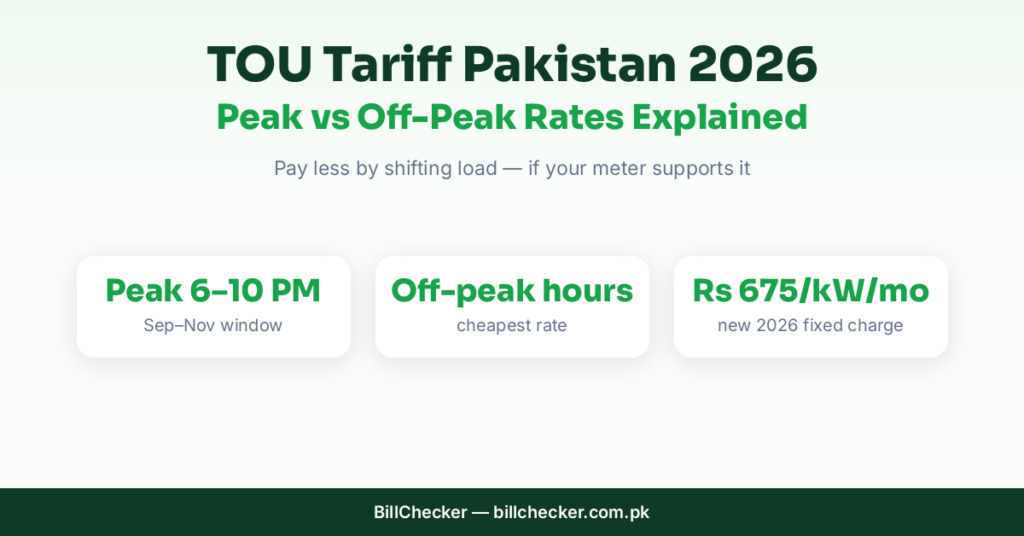
Most homes pay one flat slab rate no matter when they use electricity. But if your sanctioned load is 5 kW or more, you’re on a Time-of-Use (TOU) tariff — where a unit at 8 PM costs far more than the same unit at 2 AM. Used right, TOU is a discount machine; ignored, it’s a penalty. Here’s how it works in 2026, including the new fixed charges NEPRA added this year.
How TOU Billing Works
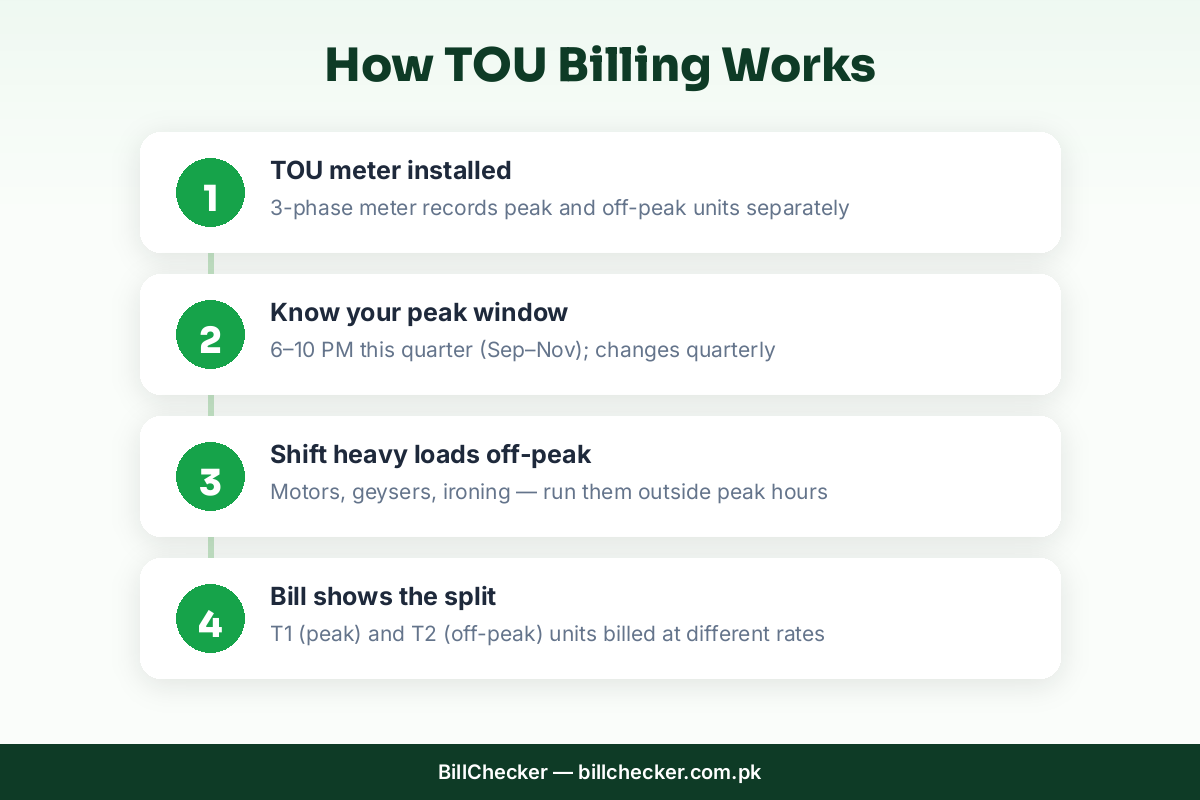
Your 3-phase TOU meter records two separate readings — T1 (peak) and T2 (off-peak) — and each is billed at its own rate:
| Period | Energy Rate (Rs/unit) | Current Window |
|---|---|---|
| Peak (T1) | Rs 46.85 | 6–10 PM (Sep–Nov) |
| Off-peak (T2) | Rs 34.53 | All other hours |
The peak window isn’t fixed — it shifts quarterly per NEPRA’s tariff framework: Dec–Feb 5–9 PM, Mar–May 6–10 PM, Jun–Aug 7–11 PM, Sep–Nov 6–10 PM. (Full calendar: peak hours guide.) A unit shifted from peak to off-peak saves you Rs 12.32 — move 100 peak units a month and that’s Rs 1,232 back.
New in 2026: Fixed Charges
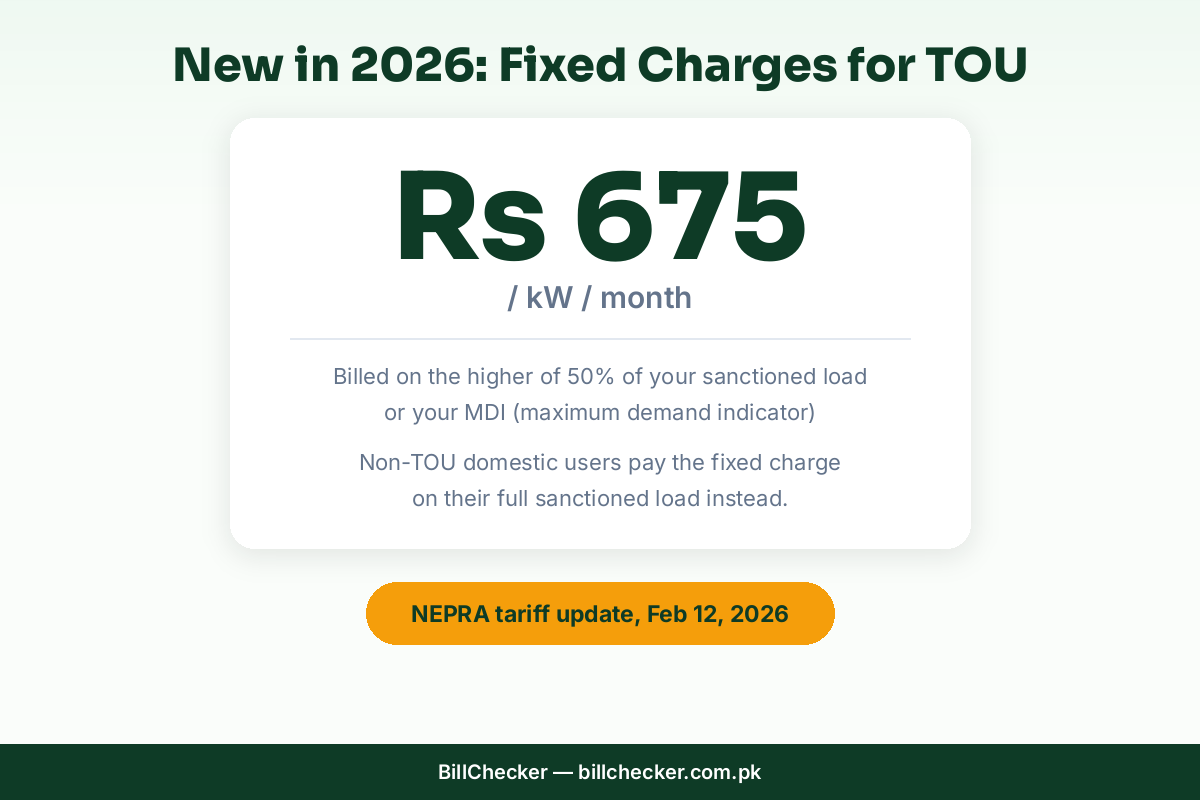
NEPRA’s February 12, 2026 tariff update added fixed charges for TOU customers: Rs 675 per kW per month, billed on whichever is higher — 50% of your sanctioned load or your recorded maximum demand (MDI). Example: a 10 kW sanctioned load means at least 5 kW × Rs 675 = Rs 3,375/month in fixed charges before you use a single unit. Non-TOU domestic users instead pay the fixed charge on their full sanctioned load. This is the single biggest TOU change in 2026 and the one most bill shock complaints trace to — check your sanctioned load on the bill before assuming the energy rate is the problem.
Is TOU Good for You?
- TOU wins if you can shift heavy loads (motors, geysers, washing, ironing) outside the 4-hour peak window. Households with daytime solar self-consumption do especially well.
- TOU hurts if your heaviest usage is 6–10 PM — cooking, ACs, and lighting all landing in peak. In that case the flat single-phase tariff would likely be cheaper, but switching back isn’t always an option once you’re on 3-phase.
- The strategy: treat 6–10 PM as expensive electricity. Timers on geysers and motors, pre-cooling rooms before 6 PM, and running the washing machine after 10 PM are the three moves that matter.
Frequently Asked Questions
Who gets the TOU tariff?
Residential connections with a sanctioned load of 5 kW or more — typically 3-phase meters. Below 5 kW you stay on the flat slab tariff.
What are the TOU peak hours right now?
6–10 PM for Sep–Nov 2026. The window changes every quarter per NEPRA’s schedule.
What is the Rs 675 fixed charge?
A per-kW monthly charge added in Feb 2026 for TOU customers, billed on the higher of 50% of sanctioned load or your maximum recorded demand.
Can I switch from TOU back to flat rates?
Generally only by changing your connection type/sanctioned load through the DISCO — it’s a formal application, not a toggle. Most 3-phase users are better off learning to shift load.
Sources
TOU energy rates (peak Rs 46.85 / off-peak Rs 34.53, 5 kW+ sanctioned load) per currently published 2026 tariff schedules; fixed-charge rule (Rs 675/kW/month on max(50% sanctioned load, MDI)) per NEPRA’s Feb 12, 2026 tariff update; quarterly peak windows per NEPRA’s tariff determinations as compiled in our peak hours guide. Rates follow NEPRA determinations and can change — check your bill’s T1/T2 lines.